Table Of Content
The first difference between an experimental approach and design-based research regards the role participants play in the experiment. In an experimental approach, the researcher is responsible for making all the decisions about how the experiment will be implemented and analyzed, while the instructor facilitates the experimental treatments. In design-based research, both researchers and instructors are engaged in all stages of the research from conception to reflection (Collins et al., 2004). In BER, a third condition frequently arises wherein the researcher is also the instructor.
Design-Based Research Invites Using Mixed Methods to Analyze Data
However, over generations of research, this connection has been all but forgotten, and DBR, although similarly inspired by the early efforts of Simon, Archer, and Jones, has developed into an isolated and discipline-specific body of design research, independent from its interdisciplinary cousin. Given the conceptual framework, theoretical and research questions, and sociopolitical interests at play, researchers may undertake this, and subsequent steps in the process, on their own, or in close collaboration with the communities and individuals in the situated contexts in which the design will unfold. As such, across iterations of DBR, and with respect to the ways DBR researchers choose to engage with communities, the origin of the design will vary, and might begin in some cases with theoretical questions, or arise in others as a problem of practice (Coburn & Penuel, 2016), though as has been noted, in either case, theory and practice are necessarily linked in the research. By employing this methodology from the learning sciences, biology education researchers can enrich our current understanding of what is required to help biology students achieve their personal and professional aims during their college experience.
Methodological Issues in the Design-Based Research Paradigm
Research subjects are co-workers with the researcher in iteratively pushing the study forward. In DBR, researchers assume the roles of “curriculum designers, and implicitly, curriculum theorists” (Barab & Squire, 2004, p.2). As curriculum designers, DBR researchers come into their contexts as informed experts with the purpose of creating, “test[ing] and refin[ing] educational designs based on principles derived from prior research” (Collins et al., 2004, p. 15). These educational designs may include curricula, practices, software, or tangible objects beneficial to the learning process (Barab & Squire, 2004). As curriculum theorists, DBR researchers also come into their research contexts with the purpose to refine extant theories about learning (Brown, 1992). Ultimately, however, these responses are likely to always be insufficient as evidence of rigor to some, for the root dilemma is around what “counts” as education science.
Experimental research designs
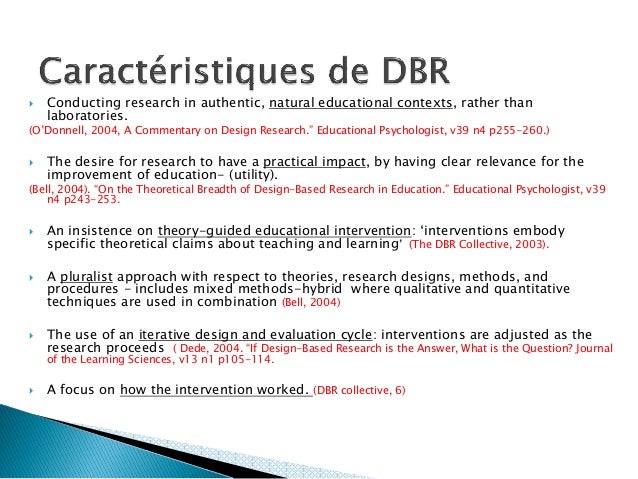
Practitioners are able to benefit from research when they see how the research can inform and improve their designs and practices. Some practitioners believe that educational research is often too abstract or sterilized to be useful in real contexts (The Design-Based Research Collective, 2002). DBR originated as researchers like Allan Collins (1990) and Ann Brown (1992) recognized that educational research often failed to improve classroom practices. They perceived that much of educational research was conducted in controlled, laboratory-like settings.
Case study

However, the iterative and multi-tasking nature of a DBR process may not be well-suited to empirically testing or building theory. According to Hoadley (2004), “the treatment’s fidelity to theory [is] initially, and sometimes continually, suspect” (p. 204). This suggests that researchers, despite intentions to test or build theory, may not design or implement their solution in alignment with theory or provide enough control to reliably test the theory in question.
An importance-performance analysis of teachers' perception of STEM engineering design education Humanities and ... - Nature.com
An importance-performance analysis of teachers' perception of STEM engineering design education Humanities and ....
Posted: Mon, 10 Apr 2023 07:00:00 GMT [source]
Specifically, in most DBR, this means a focus on “intermediate-level” theories of learning, rather than “grand” ones. In essence, DBR does not contend directly with “grand” learning theories (such as developmental or sociocultural theory writ large) (diSessa, 1991). Rather, DBR seeks to offer constructive insights by directly engaging with particular learning processes that flow from these theories on a “grounded,” “intermediate” level. This is not, however, to say DBR is limited in what knowledge it can produce; rather, tinkering in this “intermediate” realm can produce knowledge that informs the “grand” theory (Gravemeijer, 1994). For example, while cognitive and motivational psychology provide “grand” theoretical frames, interest-driven learning (IDL) is an “intermediate” theory that flows from these and can be explored in DBR to both inform the development of IDL designs in practice and inform cognitive and motivational psychology more broadly (Joseph, 2004). Put in other terms, even as DBR researchers may choose heterogeneous methods for data collection, data analysis, and reporting results complementary to the ideological and sociopolitical commitments of the particular researcher and the types of research questions that are under examination (Bell, 2004), a shared epistemic commitment gives the methodology shape.
This call for more scholarly discussion and practice resonated with designers across disciplines in design and engineering (Buchanan, 2007; Cross, 1999; Cross, 2007; Friedman, 2003; Jonas, 2007; Willemien, 2009). IDR sprang directly from this early movement and has continued to gain momentum, producing an interdisciplinary body of research encompassing research efforts in engineering, design, and technology. Design-Based Research (DBR) is one of the most exciting evolutions in research methodology of our time, as it allows for the potential knowledge gained through the intimate connections designers have with their work to be combined with the knowledge derived from research. These two sources of knowledge can inform each other, leading to improved design interventions as well as improved local and generalizable theory.
Using a Design-Based Research Framework to Develop a Breastfeeding Resource Accommodating Bloom's ... - Cureus
Using a Design-Based Research Framework to Develop a Breastfeeding Resource Accommodating Bloom's ....
Posted: Tue, 04 Apr 2023 07:00:00 GMT [source]
First of all, it is necessary to think of the best way to operationalize the variables that will be measured, as well as which statistical methods would be most appropriate to answer the research question. Thus, the researcher should consider what the expectations of the study are as well as how to analyze any potential results. Finally, in an experimental design, the researcher must think of the practical limitations including the availability of participants as well as how representative the participants are to the target population.
Understanding these shared features, in the context and terms of the methodology itself, help us to appreciate what is involved in developing robust and thorough DBR research, and how DBR seeks to make strong, meaningful claims around the types of research questions it takes up. As with any methodological approach, there can be challenges to implementing design-based research. In this new study, researchers leverage modern predictors' utilization of a Path History Register (PHR) to index prediction tables. The PHR records the addresses and precise order of the last 194 taken branches in recent Intel architectures.
This suggested that students had developed nascent flux conceptual frameworks after experiencing the instructional tools but could use more support to realize the broad applicability of this principle. Also, although our cross-sectional interview approach demonstrated how students’ ideas, overall, could change after experiencing the instructional tools, it did not provide information about how a student developed flux reasoning. A major goal of design-based research is producing meaningful interventions and practices. Within educational research these interventions may “involve the development of technological tools [and] curricula” (Barab & Squire, 2004, p. 1). But more than just producing meaningful educational products for a specific context, DBR aims to produce meaningful, effective educational products that can be transferred and adapted (Barab & Squire, 2004).
Here, using large language models (LLMs) trained on biological diversity at scale, we demonstrate the first successful precision editing of the human genome with a programmable gene editor designed with AI. To achieve this goal, we curated a dataset of over one million CRISPR operons through systematic mining of 26 terabases of assembled genomes and meta-genomes. We demonstrate the capacity of our models by generating 4.8x the number of protein clusters across CRISPR-Cas families found in nature and tailoring single-guide RNA sequences for Cas9-like effector proteins. Several of the generated gene editors show comparable or improved activity and specificity relative to SpCas9, the prototypical gene editing effector, while being 400 mutations away in sequence. Finally, we demonstrate an AI-generated gene editor, denoted as OpenCRISPR-1, exhibits compatibility with base editing. We release OpenCRISPR-1 publicly to facilitate broad, ethical usage across research and commercial applications.
Qualitative design-based research (DBR) first emerged in the learning sciences field among a group of scholars in the early 1990s, with the first articulation of DBR as a distinct methodological construct appearing in the work of Ann Brown (1992) and Allan Collins (1992). For learning scientists in the 1970s and 1980s, the traditional methodologies of laboratory experiments, ethnographies, and large-scale educational interventions were the only methods available. The laboratory, or laboratory-like settings, where research on learning was at the time happening, was divorced from the complexity of real life, and necessarily limiting. Alternatively, most ethnographic research, while more attuned to capturing these complexities and dynamics, regularly assumed a passive stance1 and avoided interceding in the learning process, or allowing researchers to see what possibility for innovation existed from enacting nascent learning theories.
Proponents of DBR believe that conducting research in context, rather than in a controlled laboratory setting, and iteratively designing interventions yields authentic and useful knowledge. Sasha Barab (2004) says that the goal of DBR is to “directly impact practice while advancing theory that will be of use to others” (p. 8). This implies “a pragmatic philosophical underpinning, one in which the value of a theory lies in its ability to produce changes in the world” (p. 6).
In this case, if the research questions being investigated produce generalizable results that have the potential to impact teaching broadly, then this is consistent with a design-based research approach (Cobb et al., 2003). However, when the research questions are self-reflective about how a researcher/instructor can improve his or her own classroom practices, this aligns more closely with “action research,” which is another methodology used in education research (see Stringer, 2013). There is, of course, much more nuance to these models, and each of these models (formative interventions, Change Laboratories, social design experiments, and participatory design research) might itself merit independent exploration and review well beyond the scope here. Indeed, there is some question as to whether all adherents of these CHAT design-based methodologies, with their unique genealogies and histories, would even consider themselves under the umbrella of DBR.




No comments:
Post a Comment